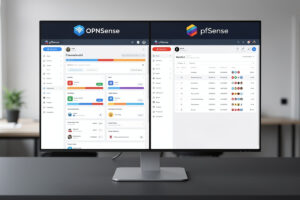
OPNsense vs pfSense in 2026 is a clearer choice than ever for most home networks — OPNsense wins for home and small business deployments, while pfSense Plus from Netgate remains relevant for enterprise commercial support. I’ve run both side by side on the same class of hardware, and the practical gap has widened: OPNsense’s faster release cadence, modern UI, and active community development outpace pfSense Community Edition’s slower cycle. For new home firewall deployments in 2026, OPNsense is my recommendation in most scenarios.
Both platforms run on FreeBSD, share core firewall capability, and trace back to the same 2015 fork. What has changed is execution. Deciso (OPNsense) ships major releases every 6 months with substantial new features. Netgate (pfSense) has been focused on commercial pfSense Plus, leaving Community Edition increasingly stagnant. The result: OPNsense pulls ahead each release cycle.
Side-by-Side Comparison
| Aspect | OPNsense | pfSense CE | pfSense Plus |
|---|---|---|---|
| Cost | Free | Free | From ~$129+/year per device on non-Netgate hardware |
| Release cadence | Every 6 months | Slower, uneven gaps (2.7.2 to 2.8.0 was ~17 months) | Quarterly |
| UI | Modern Material Design | Traditional WebGUI | Traditional WebGUI |
| WireGuard | Native, in-core (since 24.1) | Plugin (kernel module) | Native |
| Crowdsec | os-crowdsec plugin | Not available | Not available |
| Zenarmor | os-zenarmor-ce plugin | Not available | Not available |
| VLAN UI | Polished | Functional | Functional |
| 2FA | Built-in | Plugin | Built-in |
| Plugin count | 200+ | 150+ | 150+ |
| Commercial support | Deciso (limited US) | None for CE | Netgate (24/7) |
Where OPNsense Wins
Faster development. OPNsense ships major releases every 6 months (X.1 in January, X.7 in July). Each release adds substantial features — new plugins, UI improvements, performance enhancements. Compare to pfSense CE’s own release history, where the gap between 2.7.2 (late 2023) and 2.8.0 (mid-2025) stretched well over a year. For makers who value continued development, OPNsense is the more active platform.
Modern UI. OPNsense’s Material Design interface is genuinely better than pfSense’s WebGUI — drag-and-drop firewall rules, inline editing, cleaner dashboard, faster page loads. New users learn OPNsense faster; experienced users navigate it faster. UI matters for daily admin use.
Plugin ecosystem. OPNsense’s plugin architecture is more polished — better dependency management, automatic updates, and unique plugins like os-crowdsec (community threat intelligence) and os-zenarmor-ce (next-gen firewall) that pfSense doesn’t have. For security-focused deployments, OPNsense’s plugin selection is decisively better.
Where pfSense Wins
Commercial support. pfSense Plus from Netgate offers 24/7 support, hardware appliances with warranty, and enterprise-grade SLAs. For businesses that need vendor-backed support contracts (compliance, regulatory requirements), pfSense Plus is the right choice. OPNsense’s commercial support via Deciso is limited primarily to Europe.
Documentation depth. pfSense has 15+ years of accumulated documentation, YouTube tutorials, and Stack Exchange Q&A. OPNsense documentation is good but newer. For first-time users learning by searching for tutorials, pfSense has more search results — though OPNsense docs are catching up rapidly.
Hardware appliance ecosystem. Netgate sells branded hardware (SG-1100, SG-2100, SG-3100, SG-5100) optimized for pfSense. OPNsense buyers run on generic hardware (Protectli, Topton, custom builds). For buyers who want a single-vendor solution, Netgate’s appliance lineup is convenient.

Performance Comparison
Throughput on identical N100-class mini-PC hardware:
- Routing only: both platforms sit near line-rate gigabit — effectively identical
- With Suricata IDS: both take a similar, noticeable hit under full ET Open rules
- WireGuard tunnel: both reach the high hundreds of Mbps to near-gigabit, since both now run WireGuard in kernel mode
- OpenVPN tunnel: both drop well below WireGuard’s numbers, as expected for a userspace implementation
For most workloads, performance is functionally identical between the two — both share the same FreeBSD/pf foundation, so any gap comes down to specific rule sets and hardware revision rather than the platform itself. Choose based on features, UI, and ecosystem — not performance benchmarks, and re-test with your own traffic if the numbers matter for your deployment.
Migrating From pfSense to OPNsense
Migration is straightforward but manual. Backup pfSense config (Diagnostics → Backup & Restore), install OPNsense on identical or equivalent hardware, manually recreate firewall rules and VLANs (no automated XML migration between projects), test in parallel for 1-2 weeks, then cut over by swapping cables.
Time required: 6-12 hours including testing. Most pfSense users find OPNsense more polished within the first week of use. The main learning curve is UI navigation differences — concepts and capabilities are 95%+ identical. See our OPNsense setup guide for the full deployment context and OPNsense firewall rules for rule recreation.
Decision Framework
Choose OPNsense if: home or small business deployment; you value modern UI and active development; you want Crowdsec, Zenarmor, or other unique plugins; you don’t need vendor commercial support; you appreciate community-driven open source.
Choose pfSense Plus (subscriptions start around $129/year on your own hardware, free on Netgate appliances) if: enterprise deployment with compliance requirements; you need 24/7 commercial support; you prefer Netgate hardware appliances; you have existing pfSense infrastructure with operational knowledge invested.
Choose pfSense CE if: you specifically value pfSense’s accumulated tutorials and documentation; you don’t need recent feature updates; you have existing pfSense knowledge and prefer not to relearn. For new deployments in 2026, pfSense CE is hard to recommend over OPNsense given the development cadence gap.
For broader networking advice see our pfSense vs OPNsense vs OpenWrt covering the full firewall OS landscape.
2026-2028 Outlook
OPNsense is positioned for continued growth. Deciso (the company) is profitable, the community is active, and the development roadmap is published transparently on GitHub. Expected features for 2026-2027: improved Crowdsec integration, native ACME v2 client improvements, better multi-WAN UI, and enhanced VLAN management.
pfSense future is less clear. Netgate has prioritized pfSense Plus over Community Edition. If this trend continues, pfSense CE may eventually become unsupported or renamed. For users invested in pfSense, this is a real concern — consider migrating to OPNsense before pfSense CE deprecation becomes formal.
Frequently Asked Questions
Is OPNsense better than pfSense in 2026?
For most deployments, yes. OPNsense has faster release cadence (every 6 months vs pfSense CE’s stalled releases), modern Material Design UI, native WireGuard, and unique plugins (Crowdsec, Zenarmor). pfSense Plus remains relevant for enterprise commercial support but pfSense CE has fallen behind significantly.
Should I migrate from pfSense to OPNsense?
Yes for new features and active development. The migration takes 6-12 hours including testing — manual rule recreation, no automated XML migration between projects. For active users seeking continued innovation, the migration is worth the effort. For stable production deployments without specific feature needs, staying on pfSense is acceptable.
What is pfSense Plus?
pfSense Plus is Netgate’s commercial version, with subscriptions starting around $129/year per device on your own hardware (free when running on a Netgate appliance). It offers commercial support, hardware appliances with warranty, and vendor SLAs. For businesses with compliance requirements or that need vendor-backed support, pfSense Plus is appropriate. For home use, OPNsense free is the better choice.
Are OPNsense and pfSense interchangeable?
Concepts and capabilities are 95%+ identical — both run FreeBSD with pf firewall, both support similar VLAN/VPN/IDS configurations. The differences are UI, release cadence, and unique plugins. Knowledge transfers between platforms with minimal relearning. Migration takes 6-12 hours.
Is performance different between OPNsense and pfSense?
Effectively identical for typical workloads. Both platforms share the same FreeBSD/pf foundation and reach near-line-rate gigabit routing on N100-class hardware, with a similar hit once Suricata IDS is active. Any measured gap is within margin of error and not meaningful for buying decisions. Choose based on features, not benchmarks.
Why is pfSense CE development stalled?
Netgate has prioritized pfSense Plus (commercial) over Community Edition in recent years. The gap between CE releases has stretched well past a year at points (2.7.2 to 2.8.0 took over a year), even though CE is still maintained. pfSense CE remains functional but moves slower on new features than OPNsense. For users wanting more active development, OPNsense is the more responsive alternative.
What is the future of OPNsense?
Active and growing. Deciso ships major releases every 6 months with published roadmap on GitHub. Expected 2026-2027 features: improved Crowdsec, ACME v2 enhancements, better multi-WAN UI, enhanced VLAN management. Community is active, plugin ecosystem expanding. Long-term outlook is positive.
Related Articles
- OPNsense Setup Guide
- OPNsense Firewall Rules
- OPNsense WireGuard Tutorial
- pfSense Configuration Guide
- pfSense vs OPNsense vs OpenWrt